
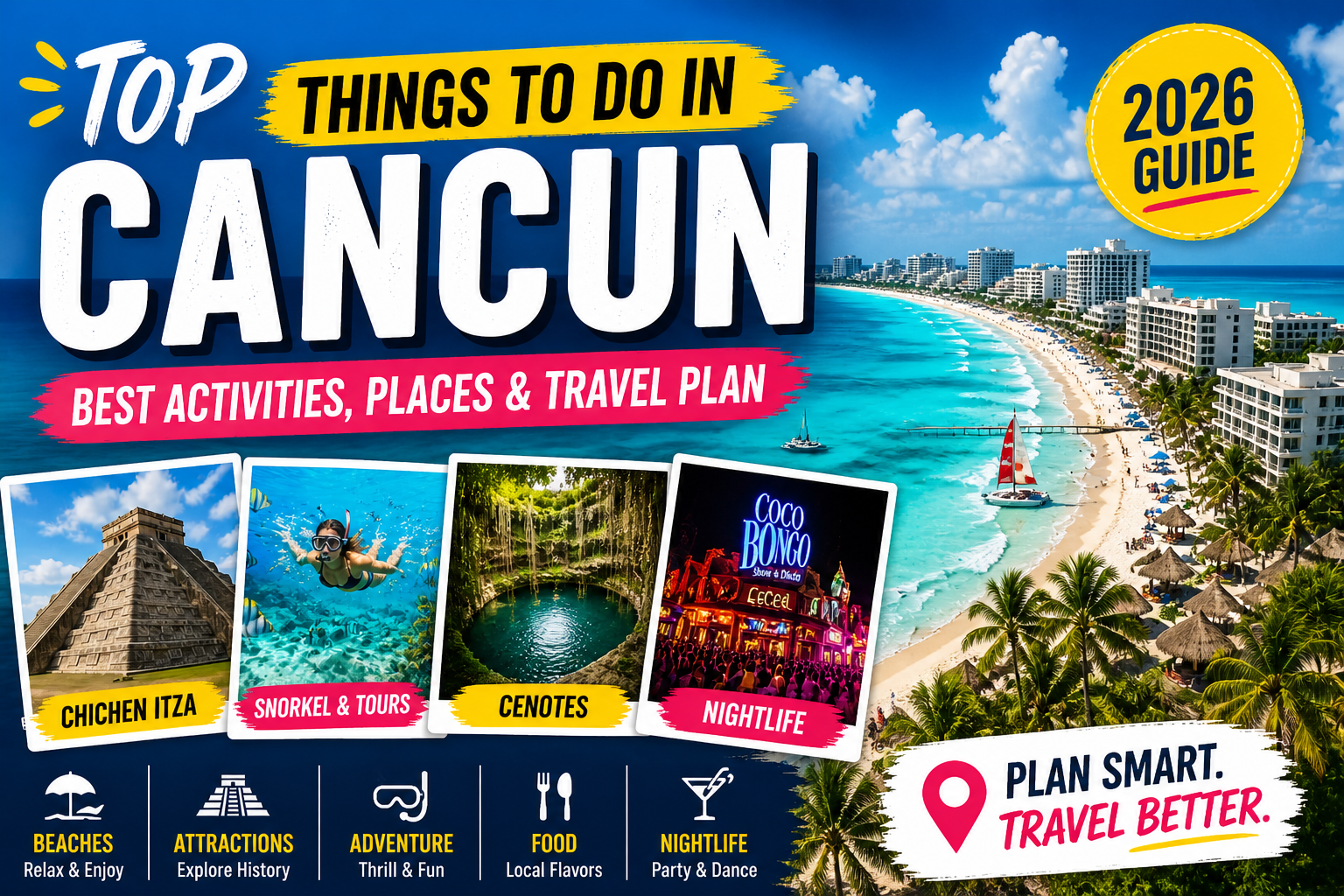
Cancun gets unfairly flattened into two clichés — either a spring-break blur of foam parties and all-inclusive wristbands, or a hushed luxury escape for couples sipping coconuts. The reality is messier, richer, and honestly far more interesting than either version. Ancient limestone sinkholes sit 40 minutes from techno clubs. You can eat a genuinely exceptional cochinita pibil taco for under a dollar, then spend the afternoon snorkeling the second-largest reef system on Earth.
This guide covers the full picture — with real logistics, honest pricing in 2025–2026 pesos, and enough specificity to save you from the generic tourist traps that drain both money and time.
Beaches in the Hotel Zone — More Than Just Sand
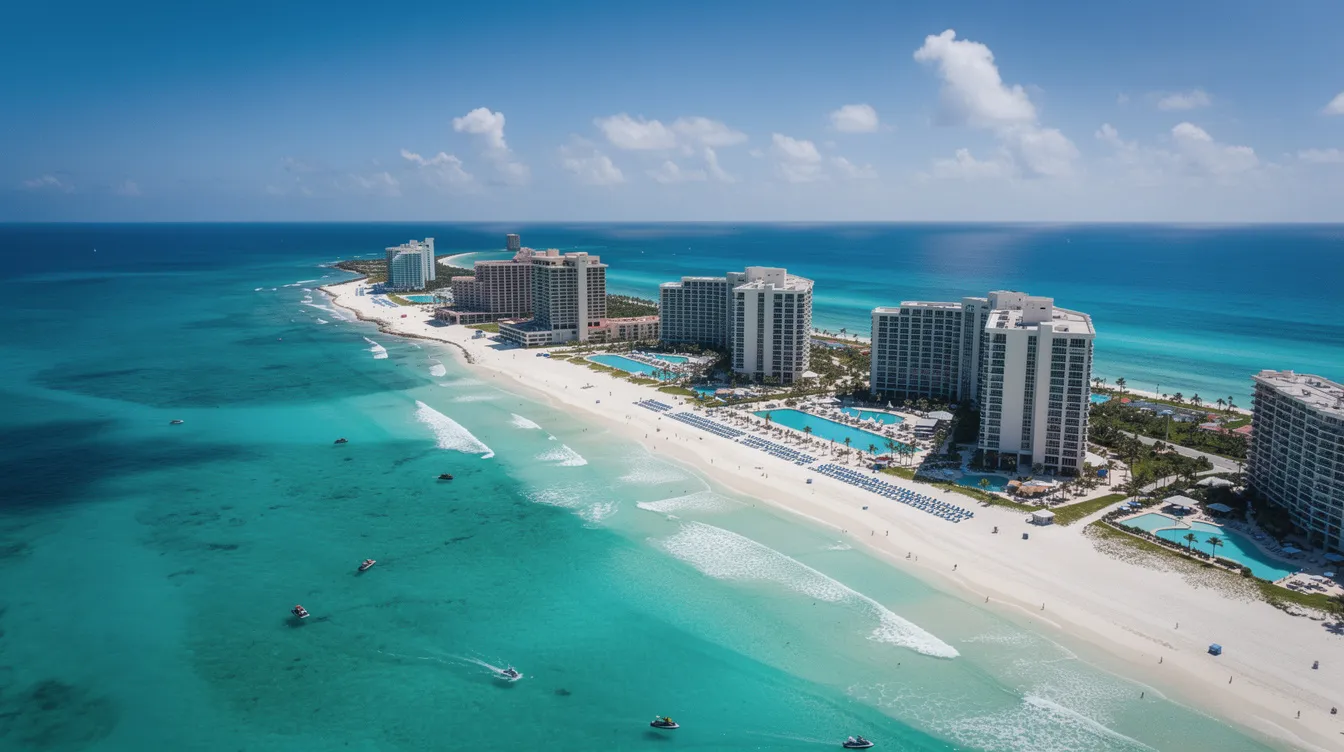
Cancun's Zona Hotelera (Hotel Zone) stretches 22 km along a narrow sandbar, with the Caribbean Sea on one side and Nichupté Lagoon on the other. Mexican federal law guarantees public access to every beach — resorts cannot legally own coastline, though they do control many access points. Knowing where to enter is half the battle.
Playa Delfines — The One Worth the Walk
At km 20, Playa Delfines is the Hotel Zone's longest undeveloped beach stretch at approximately 1.5 km. There are no resort umbrellas blocking your view. No vendors hovering. Just a wide band of powdery white sand, east-facing water that turns turquoise at sunrise, and the famous 5-meter "CANCÚN" letters sign (installed 2018) that draws every photographer for good reason.
What most guides don't mention: the currents here are genuinely strong. The red flag system is enforced by lifeguards patrolling 9 AM–6 PM, but even on calm days the undertow is noticeable. Strong swimmers only when conditions are choppy.
Getting there: R1 or R2 bus from anywhere in the Hotel Zone costs 12 MXN. The Walmart at km 20 is the landmark to watch for.
Playa Langosta — The Family Favorite
Located at km 5, Playa Langosta sees calmer water than southern beaches because of its position near Punta Sam. Depths stay under 1 meter for roughly 50 meters offshore — genuinely child-safe. There's a playground, some shade from a fringe of palm trees, and it sits right next to the Ultramar ferry pier for Isla Mujeres, making it useful as a starting point for island days.
Water temperature runs 27–29°C year-round. You won't need a wetsuit in any season.
Playa Tortugas — Action on the Sand
This one's for people who get bored lying still. A 45-meter bungee tower dominates the skyline (jumps from around 450 MXN), kayak rentals run approximately 300 MXN per hour, and a row of open-air restaurants means you don't have to leave for lunch. The ferry to Isla Mujeres also departs here if Puerto Juárez feels too far.
Minor downside: boat traffic from ferry crossings creates mild wakes that reduce the swimming quality compared to quieter stretches.
Playa Caracol & Playa Chac Mool — The Middle Ground
Between km 9–14, these two beaches front the densest cluster of hotel towers. They're popular with resort guests but accessible via a beachfront path that runs toward Punta Cancun Lighthouse — a good walk for anyone staying in the middle stretch of the Hotel Zone. Parasailing operators set up here; expect 600–900 MXN for a standard flight.
Insider tip on beach flags: Green means calm, yellow means caution, red means dangerous — and in Cancun, red flags are enforced, not suggestions. Unlike some Caribbean destinations where red flags are posted and ignored by everyone, Cancun lifeguards will physically remove you from the water. Respect it.
Isla Mujeres Day Trip — 8 km That Punch Far Above Their Weight
Just 8 km offshore from the Hotel Zone, Isla Mujeres is a narrow 7 km-long island that functions as the complete opposite of mainland Cancun. No traffic. Golf carts on half the streets. A fishing village energy that's survived rapid tourism growth largely intact.
Getting There
Three ferry departure points serve different parts of Cancun:
Practical note for high season (December–April): Ferries fill to 200-passenger capacity. Buy round-trip tickets through ClickFerry or at the pier early. Missing a return ferry during peak season isn't a mild inconvenience — afternoon ferries can be fully booked.

Playa Norte — The Poster Beach
Consistently ranked among the top 10 beaches in the world by Condé Nast and TripAdvisor, and for once the hype is warranted. The shallow gradient means you can wade 100 meters offshore and still be only chest-deep. The sand stays cool underfoot even at midday. Beach clubs like Gitano offer daybeds with a 1,000 MXN minimum spend — for groups it's reasonable, for solo travelers the free public sections are just as good.
Arrive by 9:30 AM. By 11 AM, the shade spots are gone.
Exploring the Island
Renting a golf cart (approximately 700 MXN for 4 hours) is the standard and correct way to see the island. The loop road is 35 km and manageable in half a day. Scooters are cheaper at around 500 MXN but the road has some rough patches near the southern cliffs.
Punta Sur at the southeastern tip is the sleeper attraction most day-trippers skip because it requires a short walk from the golf cart lot. The cliffs are dramatic, the old lighthouse has views over open Caribbean, and the remains of a small Mayan temple dedicated to Ixchel (goddess of fertility and medicine) are genuinely atmospheric. A sculpture garden by artist José Gpe. Rivera lines the clifftop path.
Playa Garrafon, just before Punta Sur, has snorkeling among brain coral formations. The national park entry fee (~450 MXN) is worth it for the snorkeling quality — bring your own mask to skip the overpriced rental equipment.
MUSA — The Underwater Museum
The Museo Subacuático de Arte (MUSA) sits in the channel between Cancun and Isla Mujeres, with over 1,000 life-size concrete sculptures submerged between 4–8 meters. Created by British sculptor Jason deCaires Taylor and expanded significantly through 2023, the sculptures are deliberately textured and pH-adjusted to encourage coral colonization — fish populations in the area have increased considerably since installation began.
Access options: snorkeling tour (500–800 MXN), scuba diving, or glass-bottom boat (cheaper, less immersive). Clear days in November–April offer the best underwater visibility.
Optimal Isla Mujeres timing: Catch the 8 AM ferry from Puerto Juárez, rent a golf cart by 8:45 AM, reach Punta Sur before the day-trip crowds arrive around 11 AM, swim at Playa Norte from noon, and catch a 4:30–5 PM return ferry for a sunset view crossing.
Mayan Ruins Near Cancun & Beyond
The Yucatán Peninsula has more mapped archaeological sites per square kilometer than almost anywhere in the Americas. Cancun itself has two modest local ruins. The serious sites require day trips — some closer, some longer.
Chichén Itzá — The Big One, Done Right
Distance: 200 km west of Cancun via toll highway 180D (approximately 500 MXN round-trip in tolls) Entry fee: 648 MXN for international visitors (2025–2026) Opening hours: 8 AM–5 PM daily
UNESCO World Heritage Site and one of the New Seven Wonders of the World — yes, you've heard all that. What you haven't necessarily heard is that the single biggest mistake visitors make is arriving at 11 AM on a tour bus with 400 other people in 40°C heat.
The solution is simple: Get to the gate before 8:30 AM. For the first 90 minutes, El Castillo pyramid stands in relative quiet. The astronomical precision of the structure — 365 steps representing the solar year, each face with 91 steps plus a shared top platform — reads differently when you're not shoulder-to-shoulder with strangers.
What to actually see beyond El Castillo:
- The Great Ball Court: At 83 meters long, it's the largest in Mesoamerica. The acoustics are legitimately remarkable — a clap at one end produces a distinct chirp echo at the other, a sound some researchers believe mimics the quetzal bird's call. Test it early, before the crowds make it impossible.
- El Caracol (The Snail): A circular observatory whose window alignments track Venus's 584-day cycle. The Maya used Venus as a war calendar — battle timing was calculated astronomically.
- Temple of the Warriors: Less photographed than El Castillo but architecturally fascinating, with a forest of carved columns representing Toltec warriors.
- The Sacred Cenote: A 60-meter-wide natural sinkhole north of the main complex where archaeologists recovered over 200 skeletal remains and thousands of jade, gold, and obsidian offerings in early 20th-century dredging operations. It's visually unremarkable but historically dense.
Hiring a guide: Licensed guides wait near the entrance gate and charge approximately 500 MXN per group. The difference between reading plaques and having someone explain the astronomical calendar system and the connection between Toltec and Classic Maya architecture is significant. This is one of the few situations where a guided experience is genuinely worth the cost.
Valladolid — The Overlooked Jewel Between Cancun and Chichén Itzá
Most Chichén Itzá tours stop in Valladolid for lunch and that's it. That's a mistake. This 16th-century colonial city, designated a Pueblo Mágico by Mexico's tourism authority, warrants 2–3 hours at minimum.
The historic center around Parque Francisco Cantón has kept most of its pastel-painted facades. The Calzada de los Frailes — a wide pedestrian street lined with colonial-era buildings — leads to the Convent of San Bernardino de Siena, a fortified Franciscan church from 1552 that incorporated original Maya stonework into its foundations.
Cenote Zací sits right in the city center, requires no transport, and costs 100 MXN to enter. A 15-meter swimming platform drops into a cave cenote with resident catfish and a small restaurant above. Unusual to have a cenote this accessible in a downtown setting.
For food: the market on Calle 32 near the main square has cochinita pibil prepared the traditional way — pit-roasted overnight in banana leaves, shredded, and served on handmade tortillas for 30–40 MXN per taco.
Ek Balam — The Underrated Alternative
Located 30 minutes north of Valladolid and rarely as crowded as Chichén Itzá, Ek Balam ("Black Jaguar" in Yucatec Maya) features a pyramid called the Acropolis that you can actually climb. That's increasingly rare at major sites. The stucco masks and carvings on the Acropolis are among the best-preserved in the Yucatán — the main monster-mouth doorway to the burial chamber is photographically spectacular and somehow still off most tourists' radars.
Entry: ~580 MXN. Combine with a stop at Cenote Xcanche (400 MXN including rappel access) immediately outside the park gates.
El Rey — The Local Option
For anyone staying in the Hotel Zone without a car or day-trip budget, El Rey Archaeological Zone at km 18 is the most underused site in Cancun. Free entry, 8 AM–5 PM, around 1 hour to explore. The structures date to the 14th–16th centuries and represent a late-period Mayan trading port. The site is populated with large black spiny-tailed iguanas (Ctenosaura similis) that have become habituated to humans — excellent photography without a telephoto lens.
San Miguelito ruins, adjacent to the Museo Maya de Cancun (entry 80 MXN combined), is similarly accessible and less visited than it deserves to be. The museum holds one of the better regional collections of Mayan artifacts in the Yucatán.
Swimming in Cenotes — What No One Tells You First-Time Visitors
Cenotes form through a specific geological process: the Yucatán Peninsula sits on porous limestone with essentially no surface rivers. Rainwater filters through the rock and collects in an enormous underground freshwater system called the Ring of Cenotes — a 180 km-wide arc of sinkholes that marks the rim of the Chicxulub crater, the same asteroid impact that ended the Cretaceous period 66 million years ago.
The Maya understood cenotes as sacred portals. Modern visitors understand them as some of the most spectacular swimming holes on Earth. Both interpretations are correct.
A note on sunscreen: Biodegradable sunscreen is legally mandatory at all cenotes in Quintana Roo since 2016. This is enforced through locker checks and bag searches at most sites. The water feeds the same freshwater lens that supplies drinking water to local communities — chemical sunscreens genuinely damage this ecosystem. Apply biodegradable sunscreen 20 minutes before arrival, or don't apply sunscreen at all (most cenote interiors are shaded).
Cenotes Near Chichén Itzá / Valladolid
Cenote Ik Kil (Entry: ~400 MXN) The theatrical one. A 60-meter-wide open-air sinkhole with hanging vines draping from the rim 26 meters above, black catfish visible in the clear green water below, and a spiral staircase of 270 steps for descent. Platform depths at 5 meters and 15 meters accommodate swimmers of different confidence levels. Life jackets available for 50 MXN extra.
Busiest between 10 AM and 4 PM when Chichén Itzá tour buses stop here. Arriving before 9 AM or after 3:30 PM transforms the experience.
Cenote Suytun (Entry: ~200 MXN) Famous for a single photograph: a narrow shaft lets midday sunlight fall on a stone walkway extending over the underground pool. That photo circulates constantly on travel Instagram. The reality is equally good — the water is 22°C (noticeably colder than other cenotes), and the low-ceiling cave atmosphere is unlike any open cenote. 20 minutes from Valladolid. Get there before 11 AM for the light beam effect.
Cenote Xcanahaltun (Entry: ~150 MXN) A less-visited semi-open cenote 10 km from Valladolid where most visitors are local families rather than tour groups. No large crowds, genuinely calm water, decent cliff jumping from a 3-meter ledge.
Cenotes Along the Ruta de los Cenotes (30 min south of Cancun)
Highway 307 south toward Puerto Morelos branches into a jungle road that accesses a cluster of cenotes at various price points and development levels:
Cenote Verde Lucero (Entry: ~150 MXN): Open-air jungle pool with rope hammocks strung over the water. Very low commercial development. Bring your own snacks.
Cenote La Noria (Entry: ~200 MXN, zip-line 300 MXN extra): Semi-open with a resident population of small fish and a zip-line entry over the water. The fish make for interesting snorkeling if you bring a mask.
Cenote Kin-Ha (Entry: ~250 MXN): A proper cave cenote with stalactites and the eerie dark-water swim that cave cenotes produce. Not for nervous swimmers — visibility drops once you move away from the entrance shaft. A headlamp improves the experience significantly.
This route is the most logical option for travelers without a vehicle doing a hotel-zone-based day out, as ADO buses run to Puerto Morelos and taxis from there are reasonable.
Practical Cenote Reference
Riviera Maya Day Trips — What's Worth the Drive
The coastal highway south of Cancun accesses a string of distinctly different destinations, each with its own logic and appeal.
Tulum — Go for the Ruins, Not the Hype
Distance: 130 km south (~1.5–2 hours)
The Tulum Ruins sitting atop 12-meter sea cliffs are genuinely dramatic — Entry: 90 MXN, and the combination of Caribbean backdrop and intact wall architecture is unlike any other Maya site in Mexico. Built around 1200–1450 AD as a trading port for obsidian and jade, the site is compact (45 minutes to see everything) but the setting earns the visit.
The town itself has transformed dramatically since 2020. A 2-bedroom rental that cost 800 MXN per night in 2019 now runs 3,000–4,000 MXN. Restaurant prices in the "Tulum Strip" (Carretera Tulum-Boca Paila) have tripled. The "bohemian" identity is now largely marketed to tourists with significant budgets.
Where Tulum still delivers genuine value:
- Gran Cenote: 2 km from town center, stalactites, sea turtles, freshwater visibility to 30 meters. Entry ~400 MXN, arrive at opening (8 AM) to beat tour groups.
- Cenote Dos Ojos: 20 km south, two interconnected cavern systems with 100,000-year-old stalactite formations. One of the most technically impressive cave dives in the world. Non-divers can snorkel the accessible sections. Entry ~600 MXN.
- The Sian Ka'an Biosphere Reserve: A UNESCO-protected reserve south of Tulum with boat tours through coastal lagoons and a segment of ancient Maya-built canals. Limited visitor numbers mean genuine wildlife encounters.
Puerto Morelos — The Underrated Middle Ground
Distance: 36 km south (~30 minutes)
Puerto Morelos is what some stretches of the Riviera Maya looked like before mass tourism arrived. A small fishing village with a leaning lighthouse (damaged by Hurricane Beulah in 1967, never straightened) and a genuinely relaxed pace.
The main draw is underwater: Puerto Morelos sits in the only marine national park in Mexico's Caribbean, and the Mesoamerican Barrier Reef here is exceptionally close to shore — snorkeling tours from the pier reach quality reef in under 10 minutes. Half-day tours cost approximately 500–600 MXN and commonly encounter sea turtles (green and hawksbill populations peak May–October), spotted eagle rays, and dense reef fish populations. Visibility routinely exceeds 20 meters.
On the culinary side: the row of restaurants facing the town square serve fresh fish and seafood at prices roughly 60% lower than equivalent quality in the Hotel Zone. Posada Amor, operating since 1974, is the local institution — the fish tacos are worth the trip.
Cozumel — World-Class Diving on an Island
Route: Drive or ADO bus to Playa del Carmen (~1 hour from Cancun), then Ultramar ferry to Cozumel (~45 minutes, 800 MXN round-trip)
Cozumel is primarily a diving destination, and it earns that reputation. The Palancar Reef system on the island's southwestern side offers drift dives through wall systems dropping to 1,000 meters, with current-assisted visibility of 30+ meters and a density of coral formations (brain coral, pillar coral, elkhorn coral) that rivals anywhere in the Caribbean.
For non-divers, El Cielo ("Heaven") is a shallow sandbar where Caribbean whiptail rays rest in the afternoons — boats anchor and passengers wade among dozens of rays in knee-deep water. No dive certification required.
Rent a scooter (500–600 MXN/day) from San Miguel town to loop the island's perimeter road. The eastern undeveloped coast has wild, reef-protected beaches (Playa Chen Rio is the best for swimming) and essentially no commercial development.
Eco-Adventure Parks — Context for Families
Xcaret, Xel-Há, and Xplor Adventure Park are privately operated mega-parks on the Riviera Maya corridor. They're expensive (Xcaret starts around 2,000 MXN per adult, Xel-Há all-inclusive around 1,800 MXN), engineered, and crowded during high season. That said, they reliably deliver — underground river swims, zip-lines over jungle canopy, and snorkeling in controlled conditions with excellent safety standards. For families with young children who need predictability over adventure, they're rational choices.
For everyone else, the actual natural cenotes and reefs along the same road cost a fraction of the price and deliver more.
Isla Holbox — For Extra Days and Slower Pace
Distance: 3 hours north via highway and Chiquilá ferry
Holbox (pronounced "Hol-BOSH") has no cars, no ATMs with reliable connection, streets of white sand, and water shallow enough to walk 100 meters offshore in some areas. It's the genuine escape that Tulum's marketing promises and no longer delivers.
Seasonal specifics:
- May–September: Whale shark aggregation zone nearby. Half-day tours depart from Holbox to swim alongside sharks reaching 8–12 meters. Ethical operators maintain strict no-touching, no-drone guidelines.
- June–October: Bioluminescent plankton activates in the bay after dark. Kayak tours run most nights during this window for 400–500 MXN.
The tradeoff: Holbox's remoteness means limited food and accommodation quality, and getting there requires either a long drive or connecting transport.
Snorkeling, Diving & Lagoon Adventures
The Mesoamerican Barrier Reef — Second Largest in the World
Stretching 1,000 km from Mexico's Yucatán to Honduras, the Mesoamerican Barrier Reef is the largest reef system in the Western Hemisphere and second globally. Cancun and Puerto Morelos sit at its northern end. Half-day snorkeling tours from the Hotel Zone (400–800 MXN) typically hit three sites: a shallow reef near Punta Nizuc, a sea grass bed, and a deeper coral formation.
What you'll realistically see: 65+ coral species, sergeant majors, queen angelfish, blue tang schools, and with luck, spotted eagle rays and sea turtles. May–October brings peak turtle activity (females nest on nearby beaches July–September). The nesting program run by Flora, Fauna y Cultura de México releases hatchlings on several Cancun beaches — inquiring at hotel concierges about organized hatchling releases is a genuine experience worth timing for.
Nichupté Lagoon — The Other Water World
The 22 km² lagoon between the Hotel Zone strip and the Cancun mainland is consistently underestimated. Mangrove channels, crocodile habitat, herons, and a completely different atmospheric quality from the open Caribbean — it's darker water, quieter, genuinely wild in sections.
Self-drive speedboat tours (approximately 1,000 MXN/hour for two people) launch from Hotel Zone marinas and navigate through narrow mangrove canals where American crocodiles (Crocodylus acutus) surface regularly — they're protected and habituated to boats, not dangerous in normal circumstances. Sunset timing makes the mangroves golden.
When Caribbean swells push red flags onto Hotel Zone beaches, the lagoon provides calm-water alternatives for kayaking and stand-up paddleboarding that most visitors completely miss.
Whale Shark Tours — June Through September
The open water north of Isla Mujeres and Isla Holbox hosts one of the largest seasonal aggregations of whale sharks (Rhincodon typus) on Earth. Peak season runs mid-June through mid-September, with the densest concentrations typically in late July.
Tours depart from Cancun and Isla Mujeres for approximately 3,500 MXN. Mexican regulations limit each swimmer to 30 minutes with sharks, prohibit touching, restrict fins to reduce injury risk, and limit simultaneous swimmers per shark. These regulations are actively enforced by CONAPESCA inspectors on the water.
What to know going in: Whale shark swimming involves open-ocean conditions. If the sea is rough, you'll spend significant time hanging onto the side of a small boat before reaching the sharks. Motion sickness medication is worth taking the night before and the morning of.
Cancun Food Scene — Where to Eat Beyond the Resort Buffet
The Hotel Zone's restaurant strips deliver reliable quality at inflated prices (500–1,500 MXN per main). Downtown Cancun, specifically the Avenidas Tulum and Yaxchilán corridor and Parque de las Palapas, operates at a completely different price point with food that's frequently better.
Parque de las Palapas — Cancun's Real Food Destination
The open-air market in central Cancun activates nightly from around 7 PM until midnight. Fifty-plus food stalls operate in rotating shifts, specializing in Yucatecan cooking that has been refined by generations of family recipes rather than menu consultants.
What to order:
Cochinita pibil: Slow pit-roasted suckling pig marinated in achiote paste and sour orange, wrapped in banana leaves and cooked overnight underground. UNESCO lists it as part of Mexico's intangible cultural heritage. At 80–100 MXN per taco at the market, it's also a bargain. Serve with pickled habanero onions — the acid cuts the fat perfectly.
Tacos al pastor: Lebanese immigrants brought shawarma technique to Mexico in the early 20th century; Yucatecan al pastor adds achiote and local spices to the trompo (rotating spit). Order from stalls where the spit is actively turning. Price: 35–50 MXN per taco.
Salbutes and panuchos: These are Yucatán-specific and harder to find outside the region. Salbutes are puffed fried tortillas topped with turkey, pickled cabbage, and habanero. Panuchos are similar but with refried beans pressed inside the tortilla before frying. Roughly 25–30 MXN each.
Marquesitas — The Yucatán's Signature Street Dessert
A crepe-like wafer rolled into a cone shape and filled with grated queso de bola (Edam cheese, brought by Dutch traders in the colonial period) plus a sweet element — cajeta (goat's milk caramel), strawberry jam, or Nutella. The cheese-caramel combination sounds strange and tastes excellent. Find marquesita carts near Parque de las Palapas after sunset and near Cancun's Town Hall. Cost: 40–60 MXN.
Mercado 28 — Authentic Market Shopping with Lunch
The city's largest traditional market sits 10 minutes from the Hotel Zone by taxi (40–50 MXN). The outer ring sells tourist craft goods at negotiable prices — hammocks (start at 500 MXN, negotiate toward 300–350 MXN for standard size), Talavera ceramics, dried spices, vanilla extract, and mole pastes. The inner food stalls (called fondas) serve pozole (80–150 MXN per bowl), enchiladas, and Yucatecan specialties at entirely local prices.
A Self-Guided Evening Food Walk
Avenida Yaxchilán and Avenida Tulum, running parallel through downtown, host a sequence of taquerías operating through the night. Taquería El Paisa (open 24 hours) is known locally for suadero — slow-simmered beef brisket with a crispy exterior achieved by finishing on the comal. Two or three tacos at 35 MXN each. Walk north toward a second stand for the al pastor comparison, and finish at a marquesita cart for dessert. Full dinner budget: under 200 MXN per person.
Nightlife & Evening Experiences — More Than Just Clubs
Hotel Zone Clubs
The Hotel Zone's nightlife district around Punta Cancun (km 9) operates at full volume. Coco Bongo has maintained its reputation as the definitive Cancun mega-club through three decades of ownership changes and pandemic closures — it holds up to 4,000 people, features acrobatic performers and tribute shows to artists from Michael Jackson to Shakira running alongside DJ sets, and operates 11 PM–5 AM. Cover charges run 1,500–2,500 MXN with open bar included; the experience is theatrical rather than intimate.
Other notable venues cluster on the same stretch: Mandala Beach Club for daytime-to-nighttime continuity, Dady'O for a Mexican crowd that keeps energy high until dawn.
Honest framing: Hotel Zone clubbing is genuinely unique in scale and production value. It's also extremely loud, expensive, and more about spectacle than music quality. Go for the experience, not for the DJs.
Torre Escénica — Golden Hour Without the Crowd
The rotating observation tower at El Embarcadero (admission ~250 MXN) completes a 360° rotation every 45 minutes with views east over the Caribbean and west over Nichupté Lagoon. Arriving between 5:00 PM and 6:30 PM catches the lagoon turning copper and the Caribbean going deep indigo — genuinely one of the better free-ish views in the Hotel Zone. Note this is a stationary vertical tower that rotates, not a Ferris wheel.
Xoximilco — Cultural Evening on the Water
The Xcaret group's evening canal experience (approximately 2,500 MXN) moves guests through a lagoon on trajinera boats — decorated wooden platform boats traditionally used in Xochimilco, Mexico City — with mariachi and regional music performances, all-you-can-drink tequila and mezcal, and stations serving different regional Mexican cuisines. Groups of 6–10 people get the most out of the interboat socializing that defines the experience.
Downtown Evenings — The Authentic Alternative
Parque de las Palapas transforms on weekends (Thursday through Sunday particularly) with impromptu performances — son jarocho guitarists, trova singers, occasional dance performances. The adjacent Parque de las Américas has a small amphitheater. None of this is organized for tourists. It's just what downtown Cancun does on evenings.
Locally brewed mezcal bars have opened along Avenida Uxmal in the past three years, serving artisanal spirits from Oaxaca and Guerrero. The contrast with Hotel Zone drink prices is stark: 80–120 MXN for a mezcal pour versus 300–400 MXN at Hotel Zone beach bars.
Practical Travel Information
Best Time to Visit Cancun
November and May are the optimal windows that most guides underemphasize. Shoulder months offer warm water (26–29°C), hotel prices 20–30% below peak, and occupancy that allows last-minute bookings. Weather is warm with occasional brief rain showers — the kind that pass in 20 minutes rather than the sustained afternoon downpours of peak rainy season.
Hurricane season reality check: The statistical probability of a direct hurricane hit on Cancun in any given year is low (roughly 5%). However, Category 1–2 tropical storms cause canceled tours, rough seas, and intermittent heavy rain without being dangerous. Travel insurance is standard practice for June–October visitors.
Getting Around Cancun
R1/R2 Buses: The Hotel Zone loop costs 12 MXN and runs 6 AM–midnight. For visitors staying in the Hotel Zone, this handles beach and restaurant access without the need for taxis. Air-conditioned, frequent, and comprehensively faster than tourist maps suggest.
Taxis: No meters. Rates are officially standardized (posted at major hotels), but negotiating a price before entering is the universal practice. General Hotel Zone rates: 80–150 MXN for km 5–18 range. The DiDi app runs approximately 20% cheaper for the same rides, with the advantage of a fixed price confirmed before departure.
ADO Buses: Long-distance intercity service. Chichén Itzá: 400–450 MXN, 3 hours. Tulum: 150–180 MXN, 2 hours. Playa del Carmen: 80–100 MXN, 1 hour. Buses are air-conditioned, punctual, and drop you at ADO stations in each city.
Car Rental: From approximately 500–700 MXN/day plus fuel. The freedom for cenote-hopping and flexible ruins timing is real. Downsides: Cancun airport car rental companies have generated widespread reports of forced insurance upsells and phantom damage claims. Reading the fine print on your contract, photographing the vehicle on all sides before departure, and declining additional insurance if your credit card provides rental coverage are all standard precautions.
Where to Stay
The Hotel Zone's geography divides naturally into three zones with different characters:
Northern Hotel Zone (km 1–8): Closest to downtown and the Isla Mujeres ferry. Less dramatic beach quality than the southern end. Budget: 2,000–3,500 MXN/night at mid-range hotels.
Central Hotel Zone (km 8–14): Maximum walkability to restaurants, the nightlife district, and multiple beaches. Premium location reflected in pricing: 3,000–4,500 MXN/night for quality hotels.
Southern Hotel Zone (km 16–22): The quieter, larger-resort end near Playa Delfines. Less nightlife noise, longer taxi rides downtown. 4,000–6,000+ MXN/night for large all-inclusive properties.
Downtown Cancun (Avenida Tulum area): Budget hotels at 800–1,500 MXN/night. Immediate access to local food, ADO buses for day trips, and street markets. No beach walking distance, but bus access is 12 MXN. The gap in experience between a generic Hotel Zone all-inclusive and a centrally located downtown hotel compensated by the savings in food and transport is significant — worth calculating honestly for your specific priorities.
Suggested Itinerary Frameworks
3 days: Playa Delfines on arrival afternoon. Isla Mujeres full day (Playa Norte + Punta Sur + MUSA). Chichén Itzá with Valladolid and Cenote Ik Kil.
5 days: Add Puerto Morelos snorkeling and a half-day at Ruta de los Cenotes. Add one evening at Parque de las Palapas and a downtown food walk.
7 days: Add Tulum Ruins and Gran Cenote or extend with Cozumel overnight. Hotel Zone nightlife one evening. Nichupté Lagoon speedboat on a red-flag beach day.
All prices in this guide reflect 2025–2026 rates. Exchange rates fluctuate — verify current conversions before travel.
Looking for a complete personalized day-by-day schedule with flights, hotels, and budget breakdown? TripZip builds a free custom Cancun plan in under 60 seconds based on your travel dates and interests.